Deciding on the right acquisition strategy in the United Arab Emirates often presents international buyers with a fundamental dilemma. Specifically, evaluating an off plan vs ready property strategy requires looking beyond basic market hype to analyze your personal relationship with capital and time. Most real estate discussions mistakenly treat these options as mere differences in physical construction status. On the contrary, choosing between an off plan vs ready property reflects two entirely distinct financial structures designed to solve completely different investment problems. While ready assets convert upfront capital into immediate rental income, off-plan projects spread financial commitments over time while deferring cash flow. Consequently, understanding these structural differences remains essential for overseas landlords seeking to optimize their Dubai real estate portfolios in 2026.
Analyzing the Off Plan vs Ready Property Decision Framework
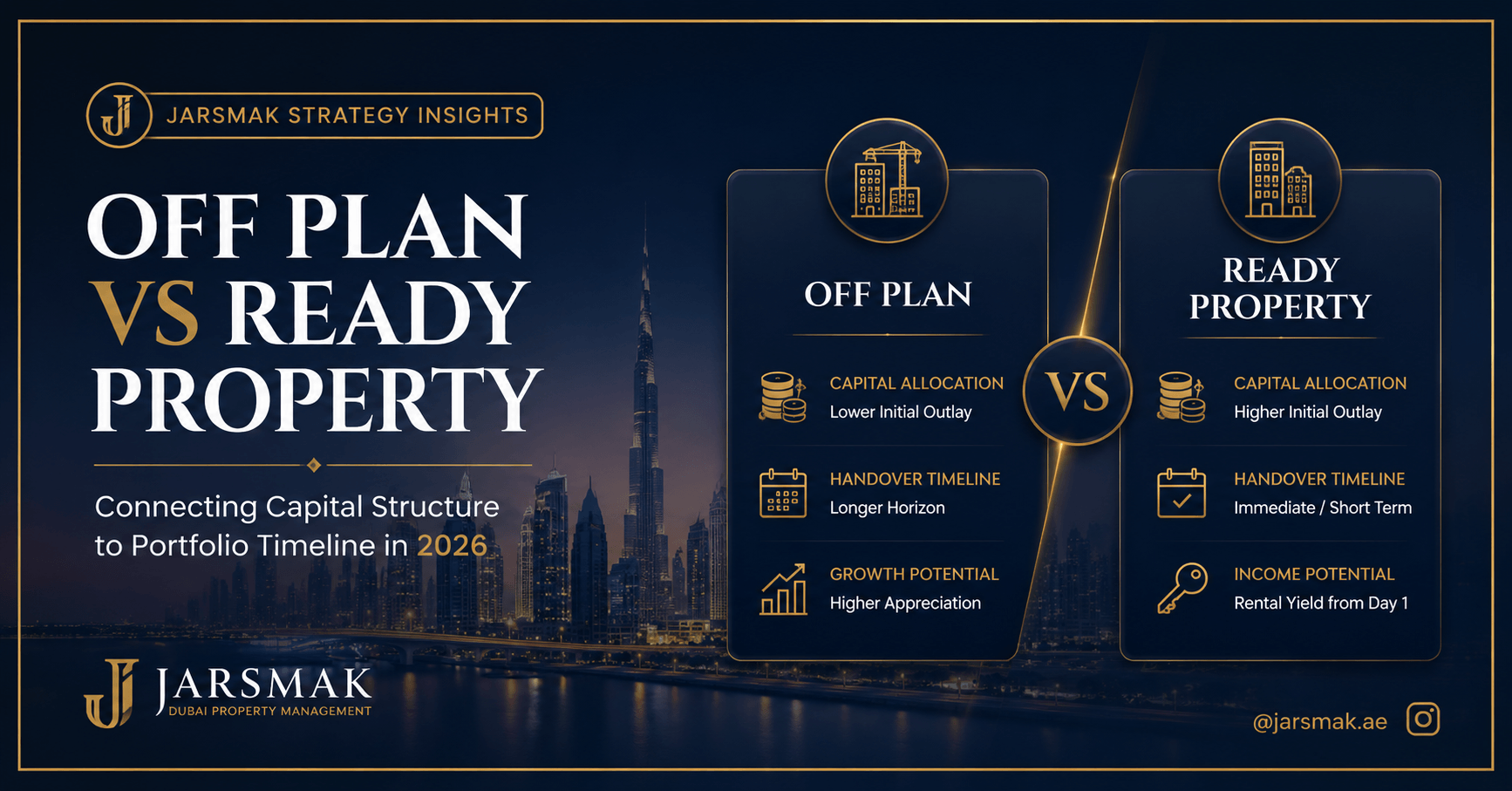
Navigating the dynamic Dubai property market requires distinguishing between immediate yield generation and staged wealth accumulation. Deploying capital into an off plan vs ready property dictates when your asset begins producing tangible cash flow. Ready properties demand a larger upfront financial commitment because you acquire a completed physical asset. In exchange, the property starts working for your portfolio from day one. In contrast, purchasing off-plan spreads your capital across structured construction milestones, asking for patience in exchange for phased market entry. Therefore, selecting one route over the other because it sounds like the smarter play often leads to misaligned expectations.
Current transactional metrics highlight how global investors deploy capital across both asset classes in 2026. During recent trading periods, total weekly real estate transactions in Dubai consistently crossed $4.2 billion (AED 15.4 billion). Furthermore, April recorded an unprecedented AED 19.7 billion in off-plan apartment sales, demonstrating immense global confidence in staged developer projects. Simultaneously, prime waterfront ready units in areas like Jumeirah and Palm Jumeirah captured record trophy sales, including a landmark $31 million apartment purchase. Undeniably, both sectors experience robust demand because they cater to different investor requirements.
Financial Dynamics of an Off Plan vs Ready Property
Examining financial structures reveals why capital positioning dictates your ideal acquisition path. Understanding how an off plan vs ready property impacts liquidity helps non-resident owners maintain financial flexibility. Ready assets typically require full settlement upfront through equity or mortgage financing, alongside immediate registration fees and transfer charges. However, this initial capital commitment immediately unlocks strong net rental yields, particularly in thriving mid-market communities. Communities like Jumeirah Village Circle (JVC), Al Barsha, and Jebel Ali generate consistent 7% to 9% rental returns for ready unit owners.
Conversely, off-plan acquisitions preserve liquidity during the construction lifecycle through staged payment plans. Developers routinely offer flexible payment structures, such as 50/50 or 60/40 schedules linked directly to certified building milestones. Additionally, government regulations require buyer installments to sit inside protected Real Estate Regulatory Agency (RERA) escrow accounts. These escrow funds are released to builders only as independent engineers verify actual site progress. Consequently, off-plan structures allow buyers to control high-value real estate while committing smaller capital increments over several years.
Cash Flow Timing and Off Plan vs Ready Property Yields
Cash flow velocity remains the primary differentiator when comparing these two investment vehicles. Analyzing cash flow reveals why an off plan vs ready property solves vastly different financial problems. If your investment strategy depends on generating immediate passive income to cover leverage or fund lifestyle requirements, waiting years for handover works against you. Ready properties allow landlords to sign tenancy contracts instantly, capitalizing on high tenant demand across business hubs. Furthermore, upcoming municipal innovations like Dubai’s 12-month interest-free rent initiative ensure landlords receive 100% of annual rent upfront via participating banks.
Alternatively, off-plan investments prioritize capital growth and phased entry over immediate cash flow. Capitalizing on entry-level pricing during early launch phases enables investors to capture equity appreciation as construction progresses. By the time handover occurs, the completed asset often commands a significantly higher market valuation than its initial booking price. However, investors must accept zero rental income during the build phase. Balancing cash flow needs against capital appreciation timelines ensures your portfolio remains resilient.
4 Strategic Questions Deciding Your Off Plan vs Ready Property Route
Evaluating personal financial parameters helps determine which structure fits your investment objectives. Answering these core questions clarifies whether an off plan vs ready property aligns with your holding horizon.
- When do you need income? If immediate rental yield is required to service debt or provide cash flow, waiting for project completion creates financial strain. Ready properties start generating rental returns instantly.
- How is your capital positioned? Committing full settlement upfront locks up liquidity immediately. Staged off-plan payment plans allow you to spread financial obligations over time while keeping capital active elsewhere.
- What is your holding horizon? Off-plan acquisitions generally reward patient investors who can hold through construction cycles. Short holding horizons rarely suit off-plan structures due to handover timelines.
- How much certainty do you require? Ready property displays the exact build quality, existing community amenities, and verified market rent today. Off-plan asks you to evaluate developer track records and future district master plans.
Risk Management in Off Plan vs Ready Property Investment
Risk profiles vary significantly across an off plan vs ready property purchase. Purchasing completed property eliminates construction delay risks, specification changes, or developer insolvency concerns. You inspect the physical building, review existing maintenance conditions, and evaluate real tenant demand before transferring funds. Nevertheless, ready properties require ongoing maintenance and active oversight to preserve asset quality over time. In fact, preventative care managed by local experts saves landlords up to 15% annually compared to reactive emergency repairs.
Meanwhile, off-plan purchases involve project execution risks that require careful developer vetting. While stringent regulatory frameworks protect buyer deposits inside escrow accounts, construction delays can still impact expected handover dates. Investors must actively monitor developer credentials, verify Sales & Purchase Agreements (SPAs), and track construction milestones via official Dubai Land Department portals. Avoiding developer red flags guarantees that your off-plan asset transitions smoothly into a high-yielding ready property upon handover.
Macroeconomic Catalysts and Future Dubai Real Estate Trends
Broader economic drivers continue fueling demand across both off-plan and completed property segments in 2026. Dubai’s retention of its #1 global ranking for greenfield FDI projects for five consecutive years underscores its unmatched economic stability. In addition, the lowering of the financial adulthood age to 18—and minor asset management to 15—opens new avenues for family legacy planning and generational wealth creation. Expanding long-term Golden Visa pathways further solidifies resident commitment, maintaining high occupancy rates across primary residential communities.
Simultaneously, Dubai’s rapid push toward a 90% digital, cashless economy streamlines remote property ownership. Initiatives such as instant digital bank account setups for international visitors eliminate traditional banking friction. Overseas landlords residing in London, New York, Singapore, or Mumbai can now manage financial transactions seamlessly. Whether acquiring off-plan units or leasing ready apartments, digitized infrastructure makes managing a Dubai portfolio remarkably frictionless.
Maximizing Portfolio Returns with Jarsmak Property Management
Selecting the right path between an off plan vs ready property represents only the first step in building a successful real estate portfolio. Maximizing long-term net yields requires dedicated local leadership, operational precision, and proactive asset care on the ground. Non-resident landlords managing properties from abroad frequently face time-zone gaps, legal compliance updates, and maintenance emergencies. Partnering with Jarsmak Dubai Property Management bridges the gap between international capital and daily operational execution.
Operating from Sobha Ivory 1 in Business Bay, Jarsmak provides non-resident landlords with complete, hands-free management solutions. From AI-driven tenant placement to automated digital reporting and 24/7 predictive care, our team protects your asset value while maintaining peak rental performance. Contact Jarsmak Dubai Property Management today or visit jarsmak.ae to receive a tailored portfolio assessment and optimize your real estate returns in Dubai.