Dubai’s property market is not being shaped only by what exists today. Some of the biggest investment opportunities may be influenced by what is being built, planned and connected for tomorrow.
From a new mega-airport and next-generation transport networks to landmark towers, cultural destinations and new waterfront communities, future Dubai projects are steadily changing how the city will work, live and attract international capital.
For property investors, however, the important question is not simply which project looks impressive. The bigger question is how new infrastructure, connectivity, tourism and population growth could influence demand for homes, offices, hospitality and retail over the coming years.
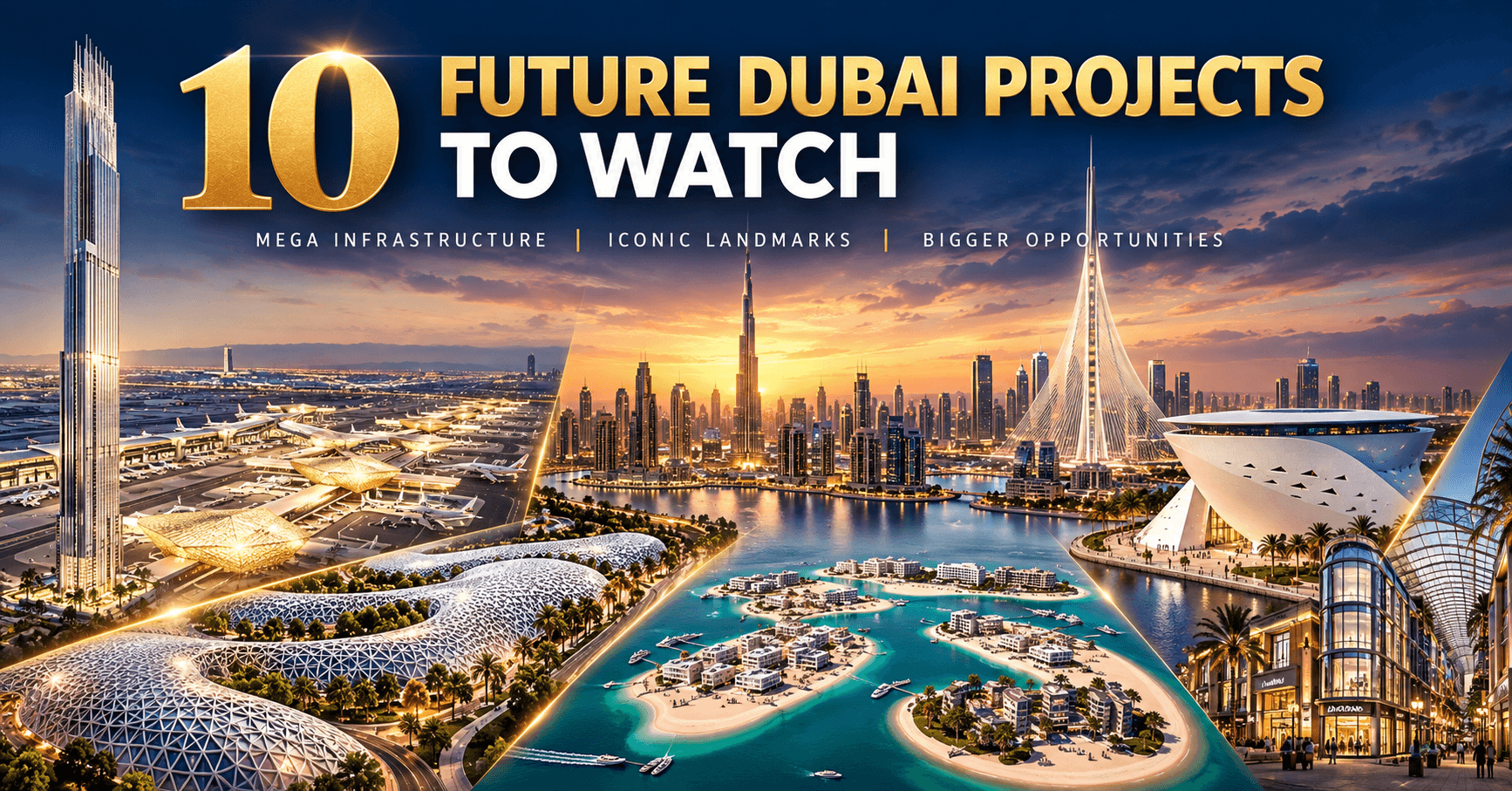
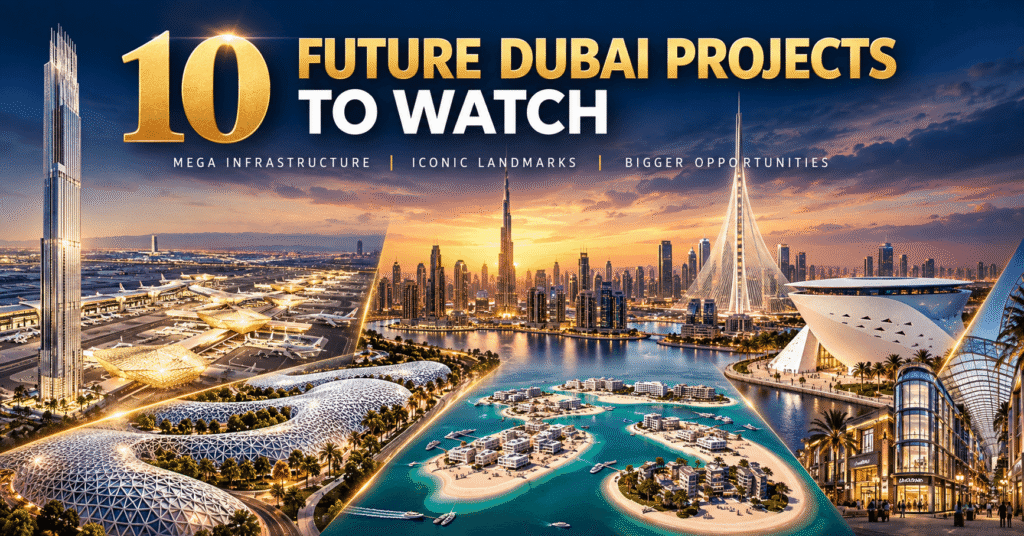
Here are 10 major developments and infrastructure initiatives worth watching as Dubai continues its transformation.
Why future Dubai projects matter to property investors
Dubai has repeatedly used infrastructure and large-scale development to open up new areas of the city. As a result, locations that once appeared distant can become significantly more accessible when roads, rail, airports and major destinations arrive.
Dubai’s long-term planning also provides an important backdrop. The Dubai 2040 Urban Master Plan is designed to guide the city’s growth, while the Dubai Economic Agenda D33 targets major expansion in economic activity and Dubai’s position as a global business hub.
Therefore, investors looking at future Dubai projects should consider more than construction timelines. Connectivity, surrounding communities, employment centres, tourism attractions and future infrastructure can all influence the long-term property story.
1. Al Maktoum International Airport
Al Maktoum International Airport at Dubai World Central is one of the most significant pieces of Dubai’s future infrastructure strategy.
The planned expansion is designed around an eventual capacity of up to 260 million passengers annually, subject to the development programme and future phases. Dubai Airports has described the project as a major long-term expansion that will ultimately support the relocation of Dubai International Airport operations.
For real estate, the implications extend beyond the airport itself. New employment, logistics, hospitality, commercial activity and transport links could support residential demand across Dubai South and surrounding districts.
2. Burj Azizi
Dubai’s skyline is set to gain another defining landmark with Burj Azizi, a planned supertall development on Sheikh Zayed Road.
Azizi Developments has announced a height of approximately 725 metres, positioning the project among the world’s tallest planned towers.
Beyond the architecture, the development is part of the continuing intensification of Sheikh Zayed Road and Dubai’s central business corridor. Luxury residences, hospitality, retail and high-end amenities could add another layer to the area’s appeal.
For investors, landmark developments can also contribute to destination branding, although the effect on individual property values will ultimately depend on location, supply, pricing and market conditions.
3. Dubai Creek Tower and Dubai Creek Harbour
Dubai Creek Harbour represents one of the city’s major waterfront master plans, while the Dubai Creek Tower remains one of its most recognisable planned architectural landmarks.
The tower concept has undergone redesign and development changes since its original announcement. Consequently, investors should distinguish between the broader Creek Harbour master plan, which is progressing, and the future form and timing of the tower itself.
The wider destination combines residential communities, waterfront promenades, retail, hospitality and public spaces. That combination makes Dubai Creek Harbour one of the future Dubai projects worth monitoring from a long-term property perspective.
4. Dubai Loop: next-generation urban mobility
Transport could become one of the most transformative elements of Dubai’s next development cycle.
The proposed Dubai Loop is a high-speed underground transportation concept developed in partnership with The Boring Company. The project has been presented as a potential underground network designed to connect important parts of the city while reducing pressure on surface roads.
If delivered at the proposed scale, the system could change how residents and visitors move between major destinations. That matters to property investors because transport accessibility is one of the factors that can influence the attractiveness of emerging neighbourhoods.
5. Dubai Museum of Art
Dubai is also expanding its cultural infrastructure. The proposed Dubai Museum of Art, associated with renowned Japanese architect Tadao Ando, is envisioned as a distinctive waterfront cultural destination.
The project is intended to strengthen Dubai’s position as an international centre for art and culture while adding another destination to the city’s growing portfolio of attractions.
For nearby real estate, cultural institutions can create additional visitor traffic and contribute to the wider identity of waterfront districts. As with all planned developments, investors should monitor official delivery milestones before making property decisions.
6. Dubai Square: a new retail destination
Dubai Square is planned as a major mixed-use retail and lifestyle destination within Dubai Creek Harbour.
The concept is significantly larger than a conventional shopping centre, incorporating retail, dining, entertainment and public spaces into the wider Creek Harbour master plan.
As a result, Dubai Square could add another major attraction to an area already positioned around waterfront living and tourism. For property owners, increased amenities and visitor activity can potentially strengthen the appeal of surrounding communities.
7. The World Islands
Dubai’s ambition to create destinations from reclaimed land is continuing through the development of The World Islands.
The archipelago was originally designed as a collection of islands representing a world map. Various sections have since been developed or proposed for luxury hospitality, residential and leisure uses.
Projects within The World Islands demonstrate another characteristic of Dubai’s property market: the creation of highly differentiated waterfront destinations. Consequently, investors interested in luxury real estate should watch how hospitality and residential development evolves across the islands.
8. Palm Jebel Ali
Palm Jebel Ali is another major waterfront development returning to Dubai’s long-term growth story.
The master development is planned as a large-scale residential, hospitality and leisure destination with extensive beachfront and infrastructure. Its location also places it within the broader expansion of Dubai’s coastal development towards the southwest.
As infrastructure improves around the area, Palm Jebel Ali could become increasingly relevant to investors looking beyond Dubai’s established central districts. However, delivery schedules, individual project launches and future infrastructure should be assessed carefully before investing.
9. Dubai Metro Blue Line
Among the most important future Dubai projects for everyday mobility is the Dubai Metro Blue Line.
The planned metro expansion is expected to connect important areas including Dubai Creek Harbour, Dubai Festival City, International City, Ras Al Khor and Mirdif. The project is planned to include approximately 30 kilometres of track and 14 stations, including both underground and elevated sections.
Construction and delivery milestones will be important to watch, with the project targeted for completion ahead of its planned 2029 opening.
For real estate investors, metro connectivity can be particularly relevant because accessibility influences commuting patterns, tenant preferences and the attractiveness of residential communities.
10. Dubai’s next-generation urban expansion
The tenth development to watch is not one individual building but the broader expansion of Dubai’s urban footprint under long-term planning initiatives.
The Dubai 2040 Urban Master Plan focuses on sustainable urban growth, improved mobility, expanded green spaces, stronger community infrastructure and the development of multiple urban centres.
That matters because the next generation of future Dubai projects will increasingly be connected rather than isolated. New housing, employment centres, transport corridors, tourism destinations and public spaces are likely to develop together.
What these future Dubai projects mean for property
When evaluating Dubai real estate, investors often focus on today’s rental yield or purchase price. Those numbers matter, but infrastructure can provide another important layer of analysis.
First, better connectivity can expand the practical rental catchment of a neighbourhood. Second, major tourism attractions can support hospitality and short-term accommodation demand. Third, new employment centres can create additional residential demand nearby.
Meanwhile, large developments can also introduce substantial new property supply. Therefore, investors should not assume that every major project automatically translates into higher prices.
A more useful approach is to examine the relationship between future Dubai projects, existing property supply, infrastructure, developer quality, service charges, rental demand and the timing of delivery.
How investors can prepare for Dubai’s next chapter
The strongest investment decisions generally begin with the fundamentals rather than the headline surrounding a new project.
- Study the location: Understand existing roads, metro connections and planned infrastructure.
- Analyse rental demand: Identify who is likely to live in the area and why.
- Compare supply: Consider how many competing units are planned or under construction.
- Check the developer: Review delivery history, project details and payment structures.
- Calculate the real costs: Include service charges, financing, maintenance and transaction costs.
- Think long term: Infrastructure-led growth can take years to translate into mature communities.
The bigger picture for Dubai real estate
Dubai’s next phase is being shaped by airports, metro lines, waterfront communities, cultural destinations, retail districts and ambitious urban planning.
Together, these future Dubai projects illustrate how the city continues to build for population growth, tourism, international business and changing lifestyles.
For property investors, the opportunity is not simply to identify the most visually impressive development. Instead, it is to understand how infrastructure and real estate interact—and then determine whether the numbers make sense for a specific investment strategy.
At Jarsmak Dubai Property Management, we help property owners and overseas investors navigate Dubai’s real estate market with a focus on property management, rental performance, tenant support and long-term ownership.
Considering investing in Dubai property? Speak with Jarsmak for practical property support and guidance tailored to your investment objectives.