Choosing between Dubai real estate developers is one of the most important decisions an investor can make when buying an off-plan or newly launched property. The developer can influence the quality of the project, construction timeline, community planning, payment structure, resale appeal and ultimately the experience of owning the property.
But there is an important distinction: there is no single developer that is automatically the “best” for every investor. The right choice depends on your budget, investment objective, location, property type, expected rental demand and risk tolerance.
In this guide, we look at some of the Dubai real estate developers investors should know, what makes a developer worth considering, and the due diligence you should complete before committing your capital.
Leading Dubai Real Estate Developers
Dubai has a large and highly structured real estate ecosystem. Developers are responsible for planning and delivering residential communities, high-rise developments, villas, commercial projects and mixed-use destinations.
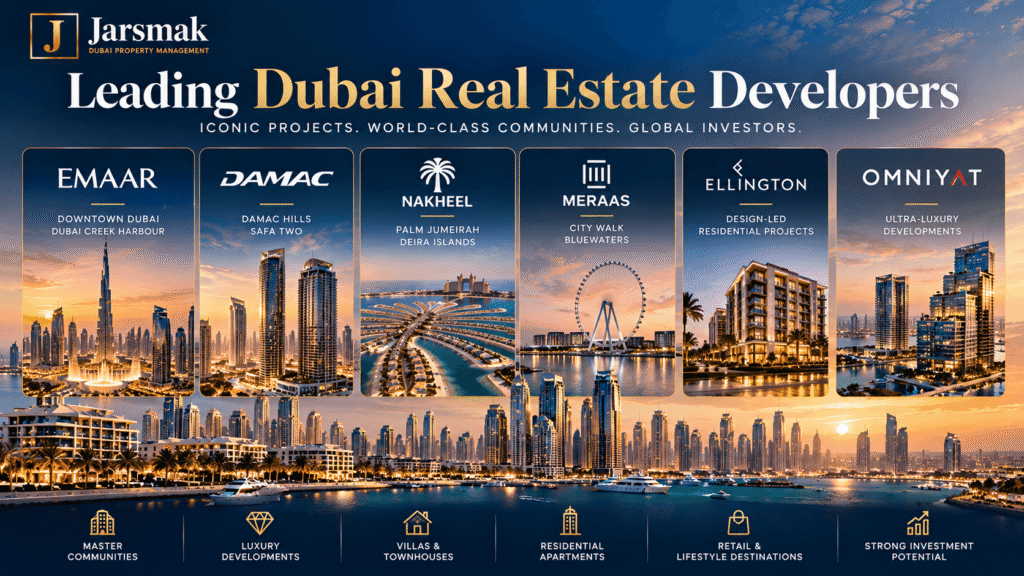
Some of the names that frequently appear in Dubai’s property market include:
- Emaar Properties
- DAMAC Properties
- Nakheel
- Meraas
- Ellington Properties
- OMNIYAT
This list is not intended to rank developers from first to last. Instead, it provides a starting point for investors researching the market.
Different developers operate across different communities, property segments and price points. A developer that is attractive for a luxury investor may not necessarily be the right choice for someone focused primarily on rental income or affordability.
1. Emaar Properties
Emaar is one of the most recognisable names in Dubai real estate and is closely associated with major destinations such as Downtown Dubai and The Dubai Mall.
For investors researching Dubai real estate developers, Emaar is worth studying because of its extensive presence in established communities and large-scale developments.
However, investors should still evaluate each individual project rather than assuming that the reputation of the developer automatically makes every property a good investment.
Consider the specific location, purchase price, service charges, rental demand, property type, payment plan and potential resale market before making a decision.
2. DAMAC Properties
DAMAC is another major name in Dubai’s residential property market, with developments across several communities and segments.
Existing Jarsmak research identifies DAMAC developments such as DAMAC Hills and Safa Two when discussing Dubai’s real estate ecosystem.
For investors considering DAMAC, the same principle applies: evaluate the individual project rather than relying solely on the developer’s brand.
Look closely at the project’s location, surrounding infrastructure, expected handover timeline, service charges, unit layouts, payment obligations and likely tenant profile.
3. Nakheel
Nakheel is particularly associated with some of Dubai’s best-known master developments, including Palm Jumeirah and Deira Islands.
Master-planned communities can offer investors an important advantage because the surrounding infrastructure, retail, hospitality and lifestyle components can influence the long-term appeal of individual properties.
Nevertheless, the same due diligence remains necessary. Investors should assess the specific property, building, service charges, rental demand and total acquisition cost rather than purchasing purely because of the developer’s name.
4. Meraas
Meraas is another prominent name within Dubai’s real estate landscape and has developed destinations combining residential, retail, hospitality and lifestyle elements.
For investors interested in premium urban locations, Meraas projects can be worth researching as part of a broader comparison of Dubai property developers.
When comparing a Meraas development with another project, focus on the fundamentals: location, entry price, expected rental demand, ownership costs, amenities and potential resale demand.
5. Ellington Properties
Ellington Properties is another developer featured in Jarsmak’s existing Dubai real estate content and is associated with design-led residential developments.
For buyers considering an Ellington project, the investment decision should still begin with the property itself rather than the marketing material.
Review the development’s location, floor plans, payment schedule, expected completion, service charges and surrounding supply before deciding whether it fits your investment strategy.
6. OMNIYAT
OMNIYAT is positioned within Dubai’s luxury property segment and is particularly relevant to investors researching premium and ultra-luxury developments.
Luxury property requires a slightly different approach to due diligence. A premium address and exceptional design can support long-term appeal, but the purchase price needs to be assessed against realistic rental income, operating costs and the depth of the resale market.
For high-net-worth investors, the question should not simply be whether a property looks impressive. The more important question is whether the underlying asset makes sense for the intended investment strategy.
There Is No Single “Best” Dubai Developer
One of the biggest mistakes investors make is asking, “Which is the best developer in Dubai?” without defining what “best” actually means.
The better question is:
Which developer and project best match my investment objective, budget and risk profile?
An investor seeking rental income may prioritise tenant demand and operating costs. Someone focused on capital appreciation may place greater importance on location, infrastructure and long-term supply. A luxury buyer may prioritise design, exclusivity and brand positioning.
That is why comparing Dubai real estate developers should always be part of a wider property-level analysis.
How to Evaluate Dubai Property Developers
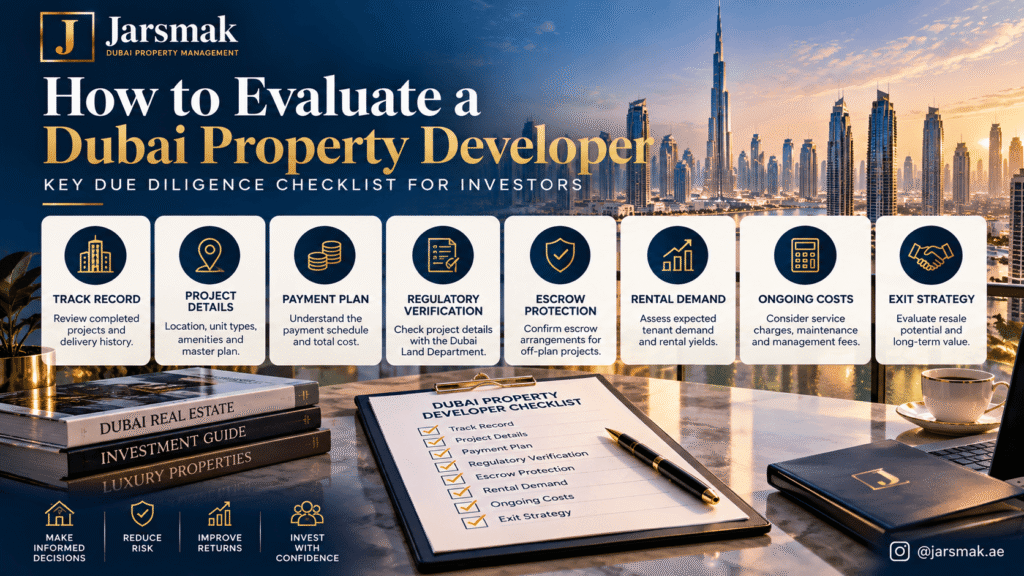
Before signing a reservation form or making an off-plan payment, work through the following checklist.
1. Research the Developer’s Track Record
Look beyond advertisements and brochures. Research the developer’s completed projects, delivery history, reputation and previous communities.
Past performance does not guarantee future performance, but it can provide useful context when comparing developers.
2. Examine the Specific Project
A strong developer can still launch projects that have very different investment characteristics.
Study the exact development, including:
- Location
- Property type
- Unit sizes and layouts
- Community infrastructure
- Amenities
- Expected completion date
- Payment schedule
- Service charges
- Expected rental demand
- Potential resale demand
3. Understand the Payment Plan
Payment plans can make off-plan property appear more affordable because the purchase price is distributed over multiple stages.
However, a flexible payment plan does not automatically make a property a better investment.
Calculate how much capital you will need at every stage and consider whether the payment schedule remains manageable if your circumstances change.
The total acquisition cost matters more than the size of the initial instalment.
4. Verify the Project and Regulatory Information
Investors should verify the relevant project and ownership information through official channels before committing funds.
The Dubai Land Department is an important official source for Dubai real estate information and regulations.
Do not rely exclusively on information provided by a salesperson or marketing brochure when making a significant investment decision.
5. Check the Escrow Arrangement for Off-Plan Property
For off-plan purchases, understanding the project’s escrow arrangements and payment structure is an essential part of due diligence.
Jarsmak’s separate guide, Dubai Developer Red Flags: 4 Signs to Avoid, explains several warning signs investors should consider before transferring funds.
If you are buying from overseas, this step becomes even more important because you may not be physically present to verify the development yourself.
Developer Reputation Is Only One Part of the Investment
A well-known developer can reduce some concerns, but it does not eliminate investment risk.
The same developer can have projects with very different locations, price points, completion timelines and rental prospects.
For that reason, investors should evaluate the following five layers:
- Developer – track record and credibility
- Project – quality, delivery and community planning
- Location – connectivity and surrounding demand
- Financials – purchase price, costs and expected income
- Exit strategy – rental income, resale or long-term holding
Only when all five make sense should an investor move forward.
Off-Plan vs Ready Property: Which Makes More Sense?
The choice between an off-plan and ready property should depend on your investment objectives.
Off-plan property can offer structured payment plans and access to new developments, but investors must consider developer risk, construction timelines, delivery and the possibility that market conditions may change before completion.
Ready property allows investors to inspect the completed asset and assess its actual location, condition, building operations and rental potential.
Neither option is automatically superior.
The right choice depends on your investment horizon, available capital, desired income and tolerance for development risk.
What Overseas Investors Should Look For
For an overseas buyer, selecting among Dubai real estate developers is only the first step.
You also need to consider what happens after the purchase.
If you live in London, Toronto, Mumbai, New York, Paris or another international market, managing a Dubai property remotely can involve tenant communication, rent collection, maintenance, inspections, renewals and financial reporting.
That is why the investment should be considered as a complete ownership cycle:
- Research
- Purchase
- Handover
- Tenant placement
- Rent collection
- Maintenance
- Inspections
- Financial reporting
- Resale or long-term holding
Our Free Dubai Property Investor Guide provides another practical starting point for overseas buyers researching the Dubai market.
Don’t Forget the Numbers
A developer’s reputation should never replace financial analysis.
Before purchasing, calculate the complete cost of ownership rather than looking only at the advertised purchase price or headline rental yield.
Your calculation should consider:
- Purchase price
- Registration and transaction costs
- Service charges
- Property management fees
- Maintenance and repairs
- Furnishing costs where applicable
- Potential vacancy
- Financing costs where applicable
- Expected rental income
Then calculate your expected net income rather than focusing only on gross rental yield.
This approach is particularly important when comparing luxury properties or off-plan developments where the headline price may not tell the full investment story.
How Jarsmak Looks at Dubai Property Investments
At Jarsmak, we believe the developer is only one piece of the investment decision.
Our approach is to look at the complete property picture: location, property type, rental demand, operating costs, ownership responsibilities and the investor’s long-term objective.
For investors who already own property in Dubai, professional property management can also help with the practical responsibilities that begin after completion.
Our Dubai property management services are designed to help property owners with ongoing responsibilities including tenant management, rent collection, maintenance coordination, inspections and property oversight.
Dubai Real Estate Developers: Investor Checklist
Before committing to a developer or project, ask yourself these questions:
- Have I researched the developer’s completed projects?
- Have I evaluated this specific project rather than just the developer’s brand?
- Is the location supported by genuine demand?
- Have I calculated the complete acquisition cost?
- Do I understand the payment schedule?
- Have I checked the relevant regulatory and project information?
- Have I considered service charges and ongoing costs?
- What is my realistic expected rental income?
- What happens if the property takes longer to complete or lease?
- What is my exit strategy?
- If I live overseas, who will manage the property after handover?
If you cannot answer these questions confidently, you may not yet have enough information to make the investment decision.
Frequently Asked Questions About Dubai Real Estate Developers
Who are some of the leading Dubai real estate developers?
Major names investors may encounter include Emaar, DAMAC, Nakheel, Meraas, Ellington Properties and OMNIYAT. The appropriate developer depends on the project, location, property type and investment objective.
Which is the best property developer in Dubai?
There is no single developer that is best for every investor. The right choice depends on factors such as project quality, location, price, payment structure, expected rental demand, costs and your investment strategy.
Should I buy directly from a Dubai developer?
Investors should conduct independent due diligence before purchasing, whether buying directly or through a broker. Review the specific project, developer, contractual obligations, payment structure and relevant regulatory information.
Are Dubai off-plan properties risky?
Off-plan property involves development and delivery risk, so investors should assess the developer, project, payment structure, expected completion and total investment cost before committing capital.
What should overseas investors check before buying?
Overseas investors should assess the developer, project, location, ownership costs, rental demand, regulations, payment obligations and how the property will be managed after completion.
Final Thoughts
Dubai offers investors an unusually broad choice of developers, communities and property types. That choice is an opportunity, but it also means buyers need a disciplined process.
The goal should not be to find the developer with the biggest name. The goal should be to find the right developer, the right project and the right property for your investment strategy.
Research the developer. Analyse the project. Verify the details. Calculate the numbers. Understand the risks. And think beyond the purchase date to how the property will perform and be managed over the years that follow.
For more resources, explore our Dubai Property Investment Guide for Buyers or browse the latest Dubai real estate insights from Jarsmak.
Thinking About Buying Property in Dubai?
If you are an overseas investor or property owner and want a clearer understanding of the Dubai market, Jarsmak can help you look beyond the sales pitch and focus on the property fundamentals.
Jarsmak: Your Dubai Property. Our Priority.